
Remarkable and Reclaimed
Timber components that are properly protected can last for centuries, which is a benefit for those who are interested in durability in the years to come. It also means that timber used in buildings long ago can still be used to make structurally sound buildings today. Timber taken from previous uses is referred to as “reclaimed” and it can be gathered from a wide variety of previous building applications, including factories and mills. Timber can even be salvaged from forest fires, sunken ships, and fallen trees that may have sunk under water or mud. The innate durability of timber gives it a long life with many possible reincarnations.
"A Timber Frame Story"
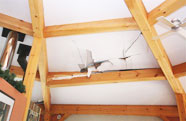
At 2:30 am, a tree came down right square on the top of the roof of our house. It hit hard because the base of the tree was just about eave height on the hill above, so when it hit the roof it was horizontal. The impact was so great the tree broke in half, and so did one of our purlins! It shattered the panel, but it did not come through! The structure held together fine but man did it scare everyone!
I have no doubt that if this had been a conventionally framed roof, the tree would have come right on through. The skylight two bays away shattered and every picture on the exterior walls fell off. The octagon shape shared the impact, much like a honeycomb or egg has a natural structural redundancy. — at Wilton, NH.
A Brooks Post and Beam Customer. (see pictures on the right)
Long-Lasting, Durable Timber Frame
Timber frame structures are known for their intense strength and durability. Built for thousands of years, they have stood the test of time and even natural disasters, including earthquakes, hurricanes, and tsunamis. Building a timber frame structure today offers these same structural advantages.
Built to Withstand
Over a thousand years ago, Japanese builders discovered the strength in building with timber. They intricately linked the timbers together with woodworking joints and developed structures that could withstand the typhoons and earthquakes common to that area. Similarly today, timber frame builders around the world are committed to structural soundness. Builders, designers, and engineers all participate in rigorous testing of the timbers and the joints that bind them. A highlight of any timber frame convention is the live audience testing of joints via a hydraulic machine. The machine pumps up to 25,000 lbs of pressure against the joint, as onlookers wait in suspense to see how much the joint is capable of withstanding. These videos show the testing of a joint and a timber beam in action.
The department of Civil Engineering at Texas A & M University is also conducting research that shows the remarkable of advantages of a timber frame under pressure. At Japan’s Hyogo Earthquake Engineering Research Center, researchers from the university conducted tests up to 7.5 on the Richter against a 7-storey timber framed building. The results are exceptional.
“Not only did the building stay together, but it met all of the performance requirements…it met all of the drift expectations. This confirms that we can design and build mid-rise wood frame structures in high seismic regions and that these structures will perform satisfactorily.”
Dr. Rosowsky, Texas A & M University
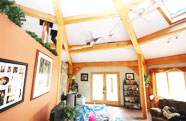
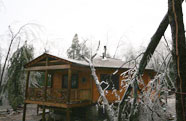
With the ability to safely withstand earthquakes, a timber frame structure is well situated to handle smaller disasters, such as the fallen tree limbs shown in the photos below. A more conventional building would likely have suffered much more significant roof and structural damage due to the same pressure.
 |
 |
 |
Backed up by history and the rigors of modern scientific testing, a home or business with a timber frame offers significant protection from the elements.
Serious Fire Resistance
Not only is the timber frame structurally sound, it also offers significant fire resistance compared to conventional light frame construction. Timber is inherently good at resisting fire due to its low thermal conductivity and the fact that the charring on the outside of the timber insulates the unburned wood beneath. This means that a larger timber must burn for an extremely long period of time before it becomes structurally unsound. As a testament to their strength, timbers that have experienced a fire can often be planed down and reused as structural beams in another project.
Links: